Nobody Owes You a Career
🇧🇷 Leia em Português
TLDR
This post is about serious study. Everything else follows from it. The two main points are:
- it is easy to see that when learning anything, you reach a satisfactory level of knowledge and stay there, around the average. Conscious effort is what takes you beyond the average;
- in the programming profession, there is no formal practice routine. That means just the fact that you practice already puts you ahead of most people.
Today I just want to share this chart, which I was thinking about last weekend while reading So Good They Can’t Ignore You by Cal Newport.
In this book, the author debunks the idea that you need to follow your passion to be happy at work. He argues that what really matters is developing valuable skills and building a solid career.
Some people really will have a stronger inclination toward certain activities, but that alone does not determine career success. Success is more about time invested and the development of skills.
The chart shows a sigmoid curve.
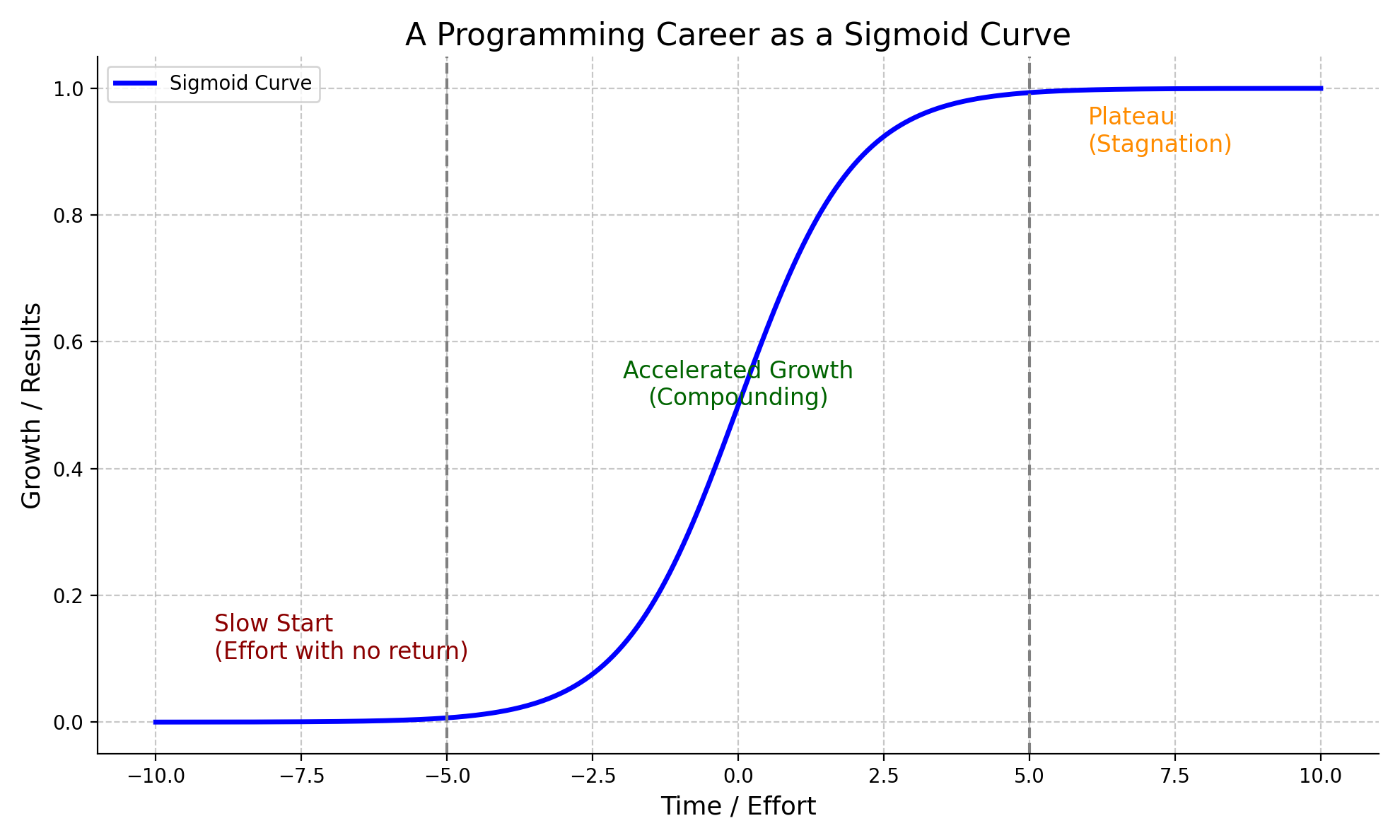
Notice how well this chart describes the path most people take in their careers. It may be your case, too.
At first, growth is slow, while you are learning and developing your skills. Over time, that growth speeds up as you become more proficient and confident.
Finally, you hit a point of stagnation (or plateau), where growth slows down or even stops. Once you are on that plateau, years of experience alone will not necessarily get you off it. It takes conscious effort.
Conscious Effort
For every sport you can think of, there is a training program. Athletes are always practicing, with the goal of improving their skills and reaching the next level.
At the Olympics, for example, it is common to see athletes breaking each other’s records (when they are not breaking their own).
That is the natural thing in sports. The athlete trains, commits and, over time, gets better results. That is not the case for most professions.
Most of us programmers don’t practice. That is why we hit the plateau and stay there.
As frustrating as that may sound, it is also an opportunity. If most people don’t practice, then if you decide to practice, you have a good chance of standing out.
How to practice is not something I will discuss here. For now, just think about athletes and how they train. They:
- repeat specific movements until they become automatic;
- are always refining some aspect that can be improved;
- get constant guidance and feedback from coaches and specialists.
You can call this conscious effort serious study or deliberate practice. It is the key to earning a great career. After all, nobody owes you one.
How Do I Know I’m on a Plateau?
First, understand that the plateau is a phenomenon. It is not necessarily bad. You will hit a ceiling of knowledge at some point, and that is normal.
After I published this article, some people asked me: but how do I know I’m on the plateau? I had formed a theory about that in my head, even before I started writing this article.
Every so often, maybe once a year, you need some kind of mental shift. Something has to change in us so we see the world from a different perspective.
At least, that is how I know I have hit a ceiling. When I went to learn C, I did it because I already understood the basics of programming, but very little about how a program is executed.